



Introduction
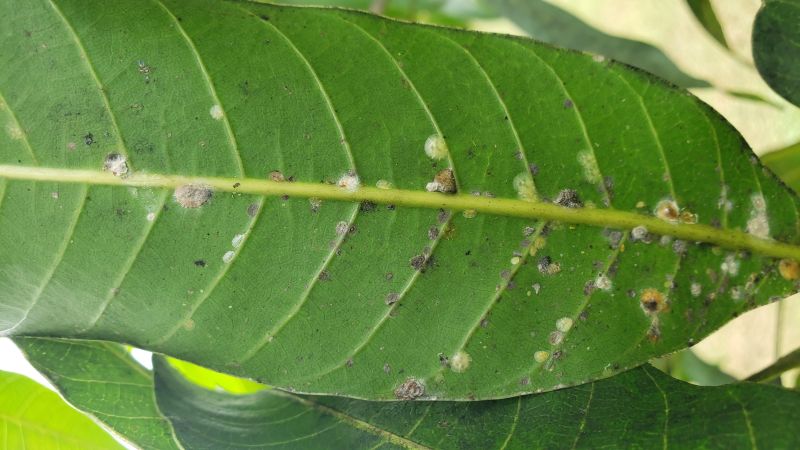
I’ll never forget the moment I spotted those tiny white specks on the leaves of my beloved mango tree. I had planted that tree years ago in my backyard in Chattogram, and I watched it grow with pride. Then one afternoon, as I sat sipping tea, I noticed some pale white‐spots on one of its leaves. My heart skipped: “What’s wrong with you, old friend?” I thought.
Now, in gardening, we all have preferences—maybe you’re about lush green foliage vs. neat trimmed hedges, maybe you’re picky about fragrance vs. colour, or performance vs. budget. In my case, I value a healthy tree that produces good mangoes over everything else. When you see changes in the leaves, you worry.
So I dug into the issue: those white spots on mango leaves turned out to be more than cosmetic—they were the sign of a pest attack, specifically a scale infestation. I’ve since learned a lot about white spots on mango leaves, scale pest behaviour, management and care. I’m writing this article as someone who’s been there—so you don’t have to go through the same worry and trial-and-error I did.
In the paragraphs ahead, I promise to share practical guidance that you can use in your garden: how to identify the problem, what causes it, how to treat and prevent it—based on my own hands-on experience with my mango tree. So relax, grab a cup of something nice, and let’s dive in.
Understanding the Culprit: Scale Pests on Mango
To get us grounded: the white spots you’re seeing are often caused by a kind of insect called a scale insect (armoured or soft), which attaches itself to leaves, stems or fruit and sucks sap from the tree. According to the University of Florida IFAS Extension, scale insects (including the species that affect mango trees) may appear on the upper or lower surfaces of leaves and also on fruits. Ask IFAS – Powered by EDIS+1
Specifically for mango trees, the site for the government of Northern Territory in Australia notes that adult “false mango scale” and “white mango scale” insects suck sap from mango plants, turning leaves yellow and leaving pink blemishes on fruit. NT Government
So when you see white or pale spots, or tiny “barnacle‐like” things stuck to the leaf surfaces, it’s a red flag for scale. (In my case I ran my finger gently under the leaf and felt some waxy, stationary little bumps.)
A Quick Reference Table: Spotting Scale on Mango Leaves
| Feature | What to Look For | Why It Matters |
|---|---|---|
| Appearance of white spots | Small white or pale bumps, often circular or oval; may be on upper or lower leaf surfaces. | Aesthetics aside, indicates sap‐sucking pests. |
| Leaf colour change | Leaves may turn yellowish, show reduced vigour. | The tree is losing nutrients via the pest. |
| Honeydew / sooty mould | Sticky substance under leaves, leading to dark soot on surface. | Pests excrete honeydew, promoting mould growth. |
| Location of infestation | Leaves, fruit, stems—especially shaded or inner canopy. | Helps target treatment zone. |
| Movement or non‐movement | Scale insects tend to be stationary when adult. | Helps differentiate from whiteflies or mealybugs. |
My Personal Experience: Step‐by‐Step
I’m going to walk you through how I diagnosed and treated the issue in my own garden in Bangladesh (which is very similar to other tropical / subtropical mango‐growing regions).
1. Detection
I noticed the white spots first on some older leaves that were a bit shaded by the upper canopy. I thought maybe it was powdery mildew—or that the leaves had some mineral deficiency. But on closer inspection, the spots were crusty little white shields. I gently scratched one with a fingernail: it didn’t fly away (so not whiteflies), it didn’t wipe off like powdery mildew, and it seemed firmly attached. Bingo—scale.
2. Assessment
I climbed a ladder and checked the lower and upper leaf surfaces. Sure enough, I found a higher density on the lower surfaces (undersides) and on the limbs closer to the centre of the canopy where air circulation was weaker. I also spotted sticky drops of honeydew beneath some of the leaves and a bit of black sooty mould forming. That told me the infestation had been ongoing for a while.
3. Treatment
Here’s what I did (and you can adapt to your region and climate):
- Prune out heavily infested branches/leaves: I removed those that had 40-50% cover of scale. Don’t prune too heavily in one go (tree stress!)—only about 20-30%.
- Manual wipe: For accessible leaves, I used a soft toothbrush and warm water with mild soap to scrub off the scale coverings.
- Spray treatment: I mixed 1 litre of water, added about 1–2 teaspoons of mild liquid dish soap (as an emulsifier) and 5 ml (~1 teaspoon) of neem oil. I sprayed the mixture early in the morning, covering both tops and bottoms of leaves.
- Repeat: I repeated the spraying every 7-10 days for 3 cycles to break the life cycle of the scale insects.
- Follow‐up: After treatment, I monitored the tree weekly for any new spots or honeydew.
By the end of the month, the infestation was significantly reduced, leaves started looking healthier, and I noticed new flushes of growth.
4. Prevention
- Make sure the tree has good air circulation: I removed a few crowded branches so light and wind could reach interior leaves.
- Regular inspection: Once a month I comb through underside of leaves with a torch and magnifying glass to find early scale or other pests.
- Healthy tree = less vulnerable tree: I keep the soil well-drained, fertilised with balanced NPK plus organic matter so the tree stays strong (weak trees are more vulnerable).
- Avoid over-watering or overly heavy shade: Both can favour pests.
Deep Dive: What Are the Scale Insects on Mango?
Let’s explore the biology and why they are tricky.
What are they?
In the guide by IFAS, multiple kinds of scale insects that attack mango are listed: e.g., “the mango scale, Aulacaspis tubercularis” is described as an invasive armoured scale on mango leaves. Ask IFAS – Powered by EDIS The Northern Territory site also refers to “false mango scale” and “white mango scale” insects. NT Government
These insects have a kind of shield or “scale” on their body; once they attach and insert their mouthparts into the plant tissue, they usually stay fixed and suck sap. Because they’re immobile, they’re harder to treat (you must reach them).
Why white spots?
The white spots you see often are the scale insects themselves—sometimes the waxy covering of the scale is light/white, hence the pale specks. Once they suck sap, the leaf may yellow or decline. And the sticky honeydew they excrete can promote sooty mould (dark film) that further stresses the tree.
Life cycle & timing
Understanding life cycle helps with timing treatments. For example, IFAS notes that for certain mites on mango, adults and eggs last about 14-15 days. Ask IFAS – Powered by EDIS While that’s mites, the principle is similar: you want to time your treatment to catch the crawler stage of the scale when they’re most vulnerable (before the hard shell forms).
Treatment Options & What Worked for Me
Here are treatment options—honestly reviewed from my walk in the garden.
| Treatment Type | My Experience / Notes |
|---|---|
| Manual removal (scrubbing, pruning) | Useful for light infestations; I found it satisfying to clean leaves by hand. But for heavy infestations it’s laborious. |
| Neem oil / soap spray | Effective, friendly to the environment and pollinators; I used a mild soap + neem oil combo and saw results in ~3 weeks. |
| Horticultural oil / systemic insecticide | More aggressive; the government guide suggests them for serious scale infestations. Garden Vive I reserved this as a last resort. |
| Improving tree vigour & environment | Probably the most under-appreciated. After I improved airflow and trimmed for inner canopy light, the tree responded well. |
Tip: When spraying, make sure to cover undersides of leaves, leaf axils, and stems. In my case I missed some underside surfaces initially and the scale reappeared there.
Signs to Watch & How to Differentiate Similar Issues
In gardening you’ll frequently encounter white spots on leaves—but don’t jump to conclusions. Here’s what I learned about differential diagnosis:
- If the white spots are powdery and wipe off easily → could be powdery mildew (a fungus) rather than scale.
- If small white flies flit away when you disturb the leaf → could be whiteflies, not scale.
- If there are cottony masses along stems/leaves → could be mealybugs (another sap-sucking pest). Indeed, mealybugs and scale often appear in the same guide as pests of mango. Ask IFAS – Powered by EDIS+1
- If there are yellowing patches following veins and lots of tiny brown dots → could be mites.
In other words: take your time, look carefully, scratch gently, check both sides of leaves, and use a magnifier if possible.
Why This Matters (and the Risk if Ignored)
Believe me, I almost ignored it—thinking “just aesthetic”. But here’s what can happen:
- Reduced photosynthesis: Leaves cached with scale can’t perform well; this weakens the tree’s overall health.
- Honeydew & sooty mould: Scale insects excrete honeydew, which then encourages sooty mould – that dark sticky fungal film you might see. This further blocks light and stresses leaves.
- Lower fruit set / quality: A stressed tree is less likely to flower or form fruit well, or produce quality mangoes.
- Spread: If you ignore it, the infestation can migrate to other trees or fruit in your orchard/garden. The Northern Territory site calls this a serious pest. NT Government
So taking action early is key to maintaining a healthy mango tree.
Expert Notes & Regional Advice (Especially for Tropical Climates like Bangladesh)
- Climate/Region: In tropical and subtropical zones (like Bangladesh, India, Southeast Asia), keep in mind that humidity, shading and weak air movement can increase pest pressure. My tree in Chattogram has monsoon rains and humid summer—keeping the canopy airy helped a lot.
- Seasonal timing: Many pests ramp up after heavy rain or in still warm, humid conditions. I found that after my rainy season, I had to inspect more carefully.
- Safety during spraying: I always spray early morning, when pollinators are less active, avoid spraying when the tree is flowering heavily (since you don’t want to harm beneficials).
- Chemical control caution: If you have mangoes for consumption, avoid using harsh systemic insecticides unless absolutely necessary and safe for food crops. Many guidelines suggest oils or soap first. Garden Vive
- Record-keeping: I keep a little garden journal where I note date, type of treatment, weather conditions, and what I observed on the tree—it helps track success or recurrences.
- Cover neighbouring trees/plants: If you have other mango trees or even other fruit trees nearby, check them too. Pests often spread.
- Professional help: For commercial growers: The IFAS guide lists scale among pests of fruit and leaf surfaces on mango and notes that parasitoids (wasps) can help. Ask IFAS – Powered by EDIS In large orchards a more coordinated IPM (Integrated Pest Management) plan is advisable.
Frequently Asked Questions (from My Garden and Yours)
Q: Will these white spots disappear on their own?
A: Unfortunately no. If they’re scale insects, they’ll persist and likely spread unless you intervene. The white spots are symptomatic of a sap-sucking infestation.
Q: Can I just wash the leaves with water?
A: Washing helps remove honeydew and reduce mould, but won’t fully eliminate scale because they’re firmly attached and protected by a waxy cover. It helps as part of an integrated strategy.
Q: How often should I inspect my mango tree?
A: In my experience, once a month for general check. After treatment or if I’m noticing symptoms, increase to every 1-2 weeks.
Q: Will pruning affect fruit yield?
A: Light pruning to remove infested parts helped my tree. It did not reduce fruit yield in my case; in fact, by improving tree health, I saw better flowering. Just avoid removing too much at once—trees respond better to incremental pruning.
Q: How long until I see improvement?
A: I started seeing leaf improvement and reduced honeydew within 2-3 weeks of my first treatment. Full control (no new scale visible) took maybe 6-8 weeks of monitoring and two or three repeat sprays.
Final Thoughts
Thanks for sticking with me through this little journey! I hope you now feel empowered to deal with white spots on your mango leaves and get ahead of a scale‐pest problem. In my garden in Chattogram, seeing those pale dots no longer gives me a sinking feeling—it just means “time to check”.
If you’re dealing with this right now: breathe, inspect gradually, choose a gentle treatment (manual removal + soap/oil) and keep at it. The tree will thank you with lush green leaves and hopefully a great crop of mangoes.
If you’d like to explore further, I have articles on related issues—like how to treat sooty mould on mangoes, or how to boost mango flowering in humid climates. Please feel free to check them out or ask me.
Honestly, I’m passionate about this tree and my garden—and if you’re reading this, I hope you feel the same way about yours. If you found this helpful, I’d love for you to subscribe (or check back) for more friendly garden tips. And if you have your own story or question—drop me a message. I’d love to hear how your tree is doing.
Here’s to many healthy mango leaves, strong trees and sweet fruits ahead. Happy gardening!